There is a possibility that your perception can be dangerously untrustworthy. It can breed arguments, produce poor decisions, sever relationships, and distort our sense of who we are. Most of the time, we do not recognize what is happening because our perception does not feel like an interpretation. It feels like reality.
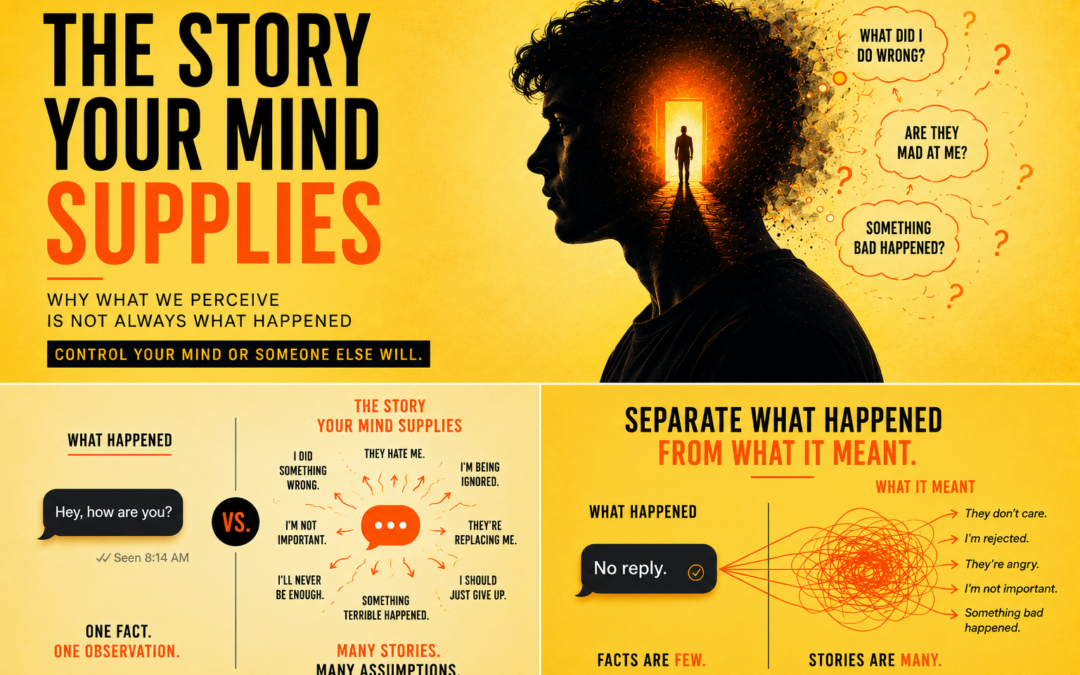
Consider a simple scenario. A text message is sent in the morning to someone who normally responds within a couple of hours. Several hours pass without a reply. By evening, the unanswered message is no longer the only issue. What began as ordinary silence has created an uneasiness we cannot shake.
Our thoughts begin circulating. What is wrong with them? What is wrong with me? Are they mad at me? Did something bad happen?
So, what is happening? We are interpreting the facts, and the facts themselves are small. A message was sent in the morning, and no response has arrived. That is all we actually know. Everything else is a story our mind supplies to fill a silence it cannot tolerate. We can interpret the delay as rejection, treat it as evidence we are not important, or assume something terrible has happened and let panic take over before a single fact confirms it. Or we can admit, however uncomfortable it feels, that we do not yet have enough information to reach an accurate conclusion.
Proverbs 18:13 warns, “If one gives an answer before he hears, it is his folly and shame.” We usually apply this to conversations. Sometimes we answer a question in our own minds before all the information has arrived, deciding what another person’s silence means before we have heard the rest of the story.
Perception Is an Interpretation, Not a Recording
Perception is what we believe we are experiencing. Perspective is the position from which we interpret and examine that experience. Perception asks, “What do I think is happening?” Perspective asks, “From what position am I interpreting what is happening, and what might I be missing?”
Perception is subjective by nature, filtered through our emotions, expectations, beliefs, wounds, and relationships. Perspective allows us to step back, weigh additional information, and consider more than one possible explanation. It is not automatically objective, since every viewpoint has limitations, but broadening our perspective moves us closer to an objective understanding than perception alone ever could.
In simple terms, perception says, “This is how the situation appears to me.” Perspective asks, “What else might be true that I cannot currently see?” Perception produces an interpretation. Perspective examines the interpretation. Our perception may be entirely sincere without being remotely accurate, and a broader perspective is what helps us finally separate what we feel, what we assume, and what the evidence actually supports.
Perception produces an interpretation. Perspective examines the interpretation.
The Lens We Bring With Us
Our perspective is shaped by our upbringing, culture, and past experiences. These influences determine which details we notice, which explanations seem reasonable, and which conclusions feel true. Two people can encounter the same unanswered message and interpret it very differently. Neither is necessarily being dishonest. Each is interpreting the same silence through a different framework. If silence has frequently been used against us as punishment, an unanswered message may activate an old fear. The present situation resembles something painful from the past, so our mind assumes the meaning must be the same. The feeling is real, but the present person may not be doing what someone else once did.
The mind is not a video camera recording reality without bias. It selects, organizes, and interprets. It searches for patterns and compares the present with what it has experienced before. This ability helps us function, but it can also cause us to mistake familiarity for certainty.

The Line Between What Happened and What It Meant
We often move from observation to interpretation without realizing we have crossed a line. “He raised his voice” is an observation. “He was trying to control me” is an interpretation of motive, while the emotional response could be “I felt threatened.” So, the interpretation of raised voices means I am unsafe may be the lens through which the entire moment is being filtered, a lens formed long before this conversation took place.
The interpretation may be correct. The person may have genuinely been trying to intimidate us. Clear thinking does not require us to deny that possibility. It requires us to separate what we know, what we feel and what we assume. Scripture never asks us to silence our instincts or ignore warning signs. It teaches us to test our conclusions. “Do not be conformed to this world, but be transformed by the renewal of your mind, that by testing you may discern what is the will of God, what is good and acceptable and perfect.” Romans 12:2.
Clear thinking asks what actually happened, what evidence supports our conclusion, what information may be missing, and what other explanations are possible. It also asks one especially difficult question: what would prove our current interpretation wrong? That question matters because the human mind naturally defends its conclusions rather than examining them. Once we decide what something means, we notice details that support the belief and overlook those that challenge it. A perception becomes a conclusion. The conclusion becomes part of the story we tell about ourselves, other people, and the world. Eventually, questioning the conclusion can feel like questioning reality itself.
Our first impression might be an old wound speaking in a new voice
Proverbs 18:17 explains, “The one who states his case first seems right, until the other comes and examines him.” The first explanation can feel complete simply because it arrived first, not because it is true. Many of us were taught to trust our first reading of a situation as though it came directly from God. No one warned us that our first impression might be an old wound speaking in a new voice.
We do not have to reject our emotions, but we should not grant them the authority of facts. Feelings can alert us that something deserves attention. They cannot always tell us why it is happening. That leaves us with a question worth sitting in before we move any further: if our first read of a moment is not always the true one, what do we do the next time we feel a conclusion forming? That is where we turn next in part 2.
And remember… control your mind or someone else will.