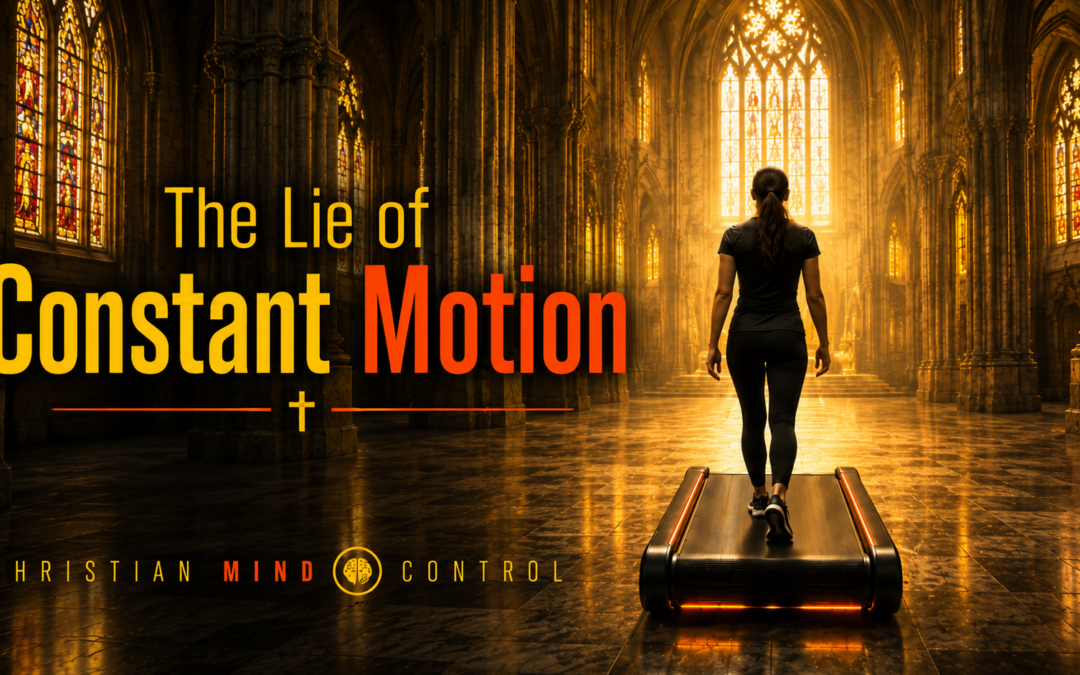
What if one of the enemy’s quietest strategies isn’t convincing us to run in the wrong direction, but convincing us we should never stop moving?
We live in a culture that celebrates hustle, applauds productivity, and rewards visible achievement. Busyness has become a badge of honor. Somewhere along the way, many of us quietly accepted a belief we never consciously chose: If I’m not constantly producing, I’m falling behind. I didn’t realize how deeply that belief had shaped my own thinking until God asked me to spend the better part of the last year doing something that would never appear on a résumé.
Last August, my husband and I made the decision to move my mom from California to Idaho so she could be closer to family. That decision meant transforming part of our home into a private studio apartment with its own entrance and fenced yard, allowing her to have both independence and support. What sounded simple on paper became months of remodeling, unexpected setbacks, countless trips to the hardware store, and more decisions than I could have imagined. By March, we were packing up Mom’s life in California, and April was spent helping her settle into a new home, a new community, and a new rhythm of life.
During that time, I intentionally put my business goals, writing projects, and many personal ambitions on hold. At first, I viewed those months as something I had to get through so I could return to what I considered my “real” work. But somewhere between painting walls, assembling furniture, and unpacking boxes, God began exposing a belief I hadn’t realized I was carrying. Why did I feel guilty for putting meaningful work on hold to care for someone I love? Why did slowing down feel so uncomfortable? Why did I feel like I had somehow fallen behind?
One of the central ideas I’m exploring through Christian Mind Control is that our minds are constantly being shaped. Every day, we absorb messages from our families, media, social platforms, workplaces, and even church culture. Over time, those messages become assumptions, and those assumptions become beliefs. The danger is that we rarely stop to ask, “Who taught me to think this way?” We often think discernment is only about recognizing false teachers or obvious deception, but it can be much quieter than that. Sometimes, taking control of your mind begins by uncovering a belief that has lived inside you for years without ever being examined. Discernment is not only recognizing who may be influencing your thinking; it is learning to question the beliefs you have already accepted as your own.
Who taught me to think this way?
Scripture presents a very different picture of faithfulness than our culture does. The Bible is filled with seasons of planting, waiting, building, grieving, rejoicing, harvesting, and resting. None of those seasons are accidental. Each one accomplishes something God intends. Jesus Himself spent thirty years in relative obscurity before three years of public ministry. Throughout His ministry, He regularly withdrew from the crowds to pray. He was never driven by urgency or manipulated by other people’s expectations. He simply remained faithful to what the Father had placed before Him. That’s a very different definition of success.
When the apartment was finally finished and Mom was settled, I assumed I’d immediately dive into the next big project. Instead, something unexpected happened. May and June became a season of restoration. Rather than rushing into another assignment, my husband and I intentionally embraced the pause. We took a few short trips, rediscovered hobbies we had set aside, enjoyed evenings that weren’t driven by deadlines, and allowed ourselves to simply breathe again.
At first, that felt almost irresponsible. Then I realized something: the pause wasn’t keeping me from God’s purpose. It was part of God’s purpose.
I’m becoming convinced that one of the enemy’s quietest strategies is to keep us moving so fast that we never stop long enough to ask whether we’re moving in the right direction. Noise drowns out reflection. Hurry crowds out discernment. The pause isn’t the space between God’s work. Sometimes the pause is God’s work.
What if stopping is obedience?
Rest isn’t laziness. It’s where God often restores perspective, renews strength, reveals misplaced priorities, and prepares us for whatever comes next. We don’t pause because we’ve earned it. We pause because God designed us to need it.
My hope is that this encourages anyone who feels like life has been put on hold. Maybe you’re caring for aging parents. Maybe you’re rebuilding after loss, walking through illness, or faithfully carrying responsibilities that no one else sees. Don’t assume you’ve stepped off God’s path simply because you’ve stepped off your timeline. The dreams you’ve set aside aren’t necessarily gone. They may simply be waiting for the next season.
So, let me leave you with the question God has been asking me: Who taught you that faithfulness always looks like forward motion?
Maybe it’s time to examine that belief.
Because if we don’t intentionally examine the beliefs shaping our minds, someone else will gladly do the shaping for us.
And remember,
Control your mind, or someone else will.